Showing posts with label poets. Show all posts

Tuesday, August 2, 2011

Raymond Carver (1938-1988)

And did you get what

you wanted from this life, even so?

I did.

And what did you want?

To call myself beloved, to feel myself

beloved on the earth.

Those words are inscribed on the tombstone of Raymond Carver, the starkly minimalist and massively influential author of stories about what people talk about, and what they don't talk about.

Less is more has been a credo since the turn of the 20th century but Carver went to extremes. Much of this was the influence of Esquire magazine editor Gordon Lish, who performed "surgical amputation and transplantation" on Carver's stories in what was perhaps the most important and influential author/editor relationship since Ezra Pound took a red pen to T.S. Eliot's The Wasteland. Carver eventually broke with Lish and their relationship is being critically reevaluated. In 2009, thanks to efforts by his widow, the poet Tess Gallagher, his seminal What We Talk About When We Talk About Love was republished with the original drafts of the stories, often twice as long as the versions that were published by Lish, as Beginners.

A lifelong alcoholic, Carver said of his time with John Cheever Iowa Writers' Workshop that they did no writing, little teaching, and much drinking. Thanks to Alcoholics Anonymous, he quit drinking, which he thought would kill him, at age 40. When he learned he had lung cancer ten years later, he thought of that decade as a bonus and wrote a poem about it called "Gravy", which reads in part:
No other word will do. For that's what it was.Gravy.
Gravy, these past ten years.
Alive, sober, working, loving, and
being loved by a good woman...

Carver died of lung cancer on August 2, 1988 at the age of 50.

Friday, July 8, 2011

Percy Bysshe Shelley (1792-1822)

Today Percy Shelley is known for being one of the key figures in Romantic poetry, author of "Ozymandias", "Ode to the West Wind", "Hymn to Intellectual Beauty," "To a Skylark", "Adonaïs", and Prometheus Unbound. In his day, he was as much known for his tumultuous and controversial life as for his written works.

Son of an MP, he was tormented at Eton and returned the favor to polite society as an adult. Legend says that at Oxford he attended only one lecture but spent sixteen hours a day reading. He was also writing just as furiously, publishing two novels, two poetry collections, and a pamphlet on atheism. It was the later that got him kicked out of Oxford.

Four months later, the nineteen year old Shelley eloped with sixteen year old Harriet Westbrook. Three years later he left his pregnant wife for another sixteen year old, the daughter of philosophers William Godwin and Mary Wollstonecraft, Mary Wollstonecraft Shelley, the future author of Frankenstein. Harriet committed suicide a few weeks before they married.

After 1818, the Shelleys lived in Italy. They found it freer, politically and intellectually, and it attracted a lot of fellow travelers like their friend, the poet Lord Byron. In 1822, he had built a "perfect plaything for the summer", a small sailing boat. Initially dubbed the Don Juan, after one of Byron's poems, Shelley rechristened it the Ariel. A defiant Byron painted "Don Juan" on the mast; the Shelleys thought it made the boat look like a coal barge.

On July 8, 1822, Shelley, retired British Navy lieutenant Edward Ellerker Williams, and boat boy Charles Vivien were sailing from Livorno to Lerici when they were caught in a severe storm. What happened that night has been much speculated upon. Mary Shelley later wrote that the boat was never seaworthy. It's generally thought the seamanship of the three men was not equal to the task of riding out the storm. More fanciful theories include a politically motivated assassination or an attack by pirates. Whatever happened, ten days later, three bodies washed ashore at Viareggio. In Shelley's pocket was a volume of poems by John Keats, the fellow Romantic poet whose early death at 25 Shelley celebrated in "Adonaïs", still open to the page he had been reading. Shelley had been one month away from 30.

Byron and others in their circle cremated Shelley's body on the beach. The ashes were buried in a cemetery in Rome. A crass Tory newspaper crowed: "Shelley, the writer of some infidel poetry, has been drowned, now he knows whether there is God or no." Accounts differ on what exactly became of his heart, but many say that it was plucked from the flames intact and kept by Mary Shelley for the rest of her life.

Friday, July 1, 2011

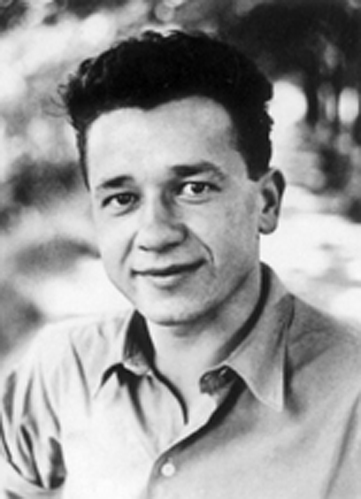
Tadeusz Borowski (1922-1951)

Polish author Tadeusz Borowski was born in Zhytomyr in the Ukraine. His parents were victims of the Soviet Gulag and forced resettlement until the family was repatriated to Poland and settled in Warsaw. When the Nazis occupied Poland, Borowski was part of the educational and literary underground, studying literature in secret schools, writing for underground newspapers, and secretly publishing his first poetry collection, Gdziekolwiek Ziemia (Wherever the Earth).

In 1943, he and his fiancee were arrested by the Gestapo in the apartment of a close friend. and eventually ended up in Auschwitz. They were spared the gas chamber because at that point the Nazis were (for the most part) only gassing Jews. Borowski worked at the railway ramp where arriving Jews were relived of their belongings and herded to the gas chambers. Once, on a work detail to Birkenau, he was able to see his fiancee again briefly and at the sight of her shaven head told her "Don't worry, our children won't be bald."

After the war, he and his fiancee were resettled in different countries, but he persuaded her to leave Sweden and return to Poland, now a communist country, and they married. He worked as journalist and wrote his masterpiece, Pożegnanie z Marią (Farewell to Maria, translated into English as This Way for the Gas, Ladies and Gentlemen), a collection of dark and darkly comic stories about his experience at Auschwitz. His talent was obvious, but his work was denounced for "amorality, decadence, and nihilism". Initially enthusiastic about communism, he became disillusioned. The close friend who was arrested by the Gestapo was now arrested and tortured by the communists.

On July 1, 1951, three days after the birth of his daughter, Borowski committed suicide using a gas stove. It was his third suicide attempt. He was 28.